We are officially past the point where air cooling can even pretend to keep up.
For the last two years, the conversation surrounding AI infrastructure has been dominated by chips and power grids. We have watched with bated breath as NVIDIA unveiled its Blackwell and Vera Rubin architectures, and we have listened to hyperscalers warn that the grid simply cannot supply the sheer gigawatts required to fuel the AI boom.
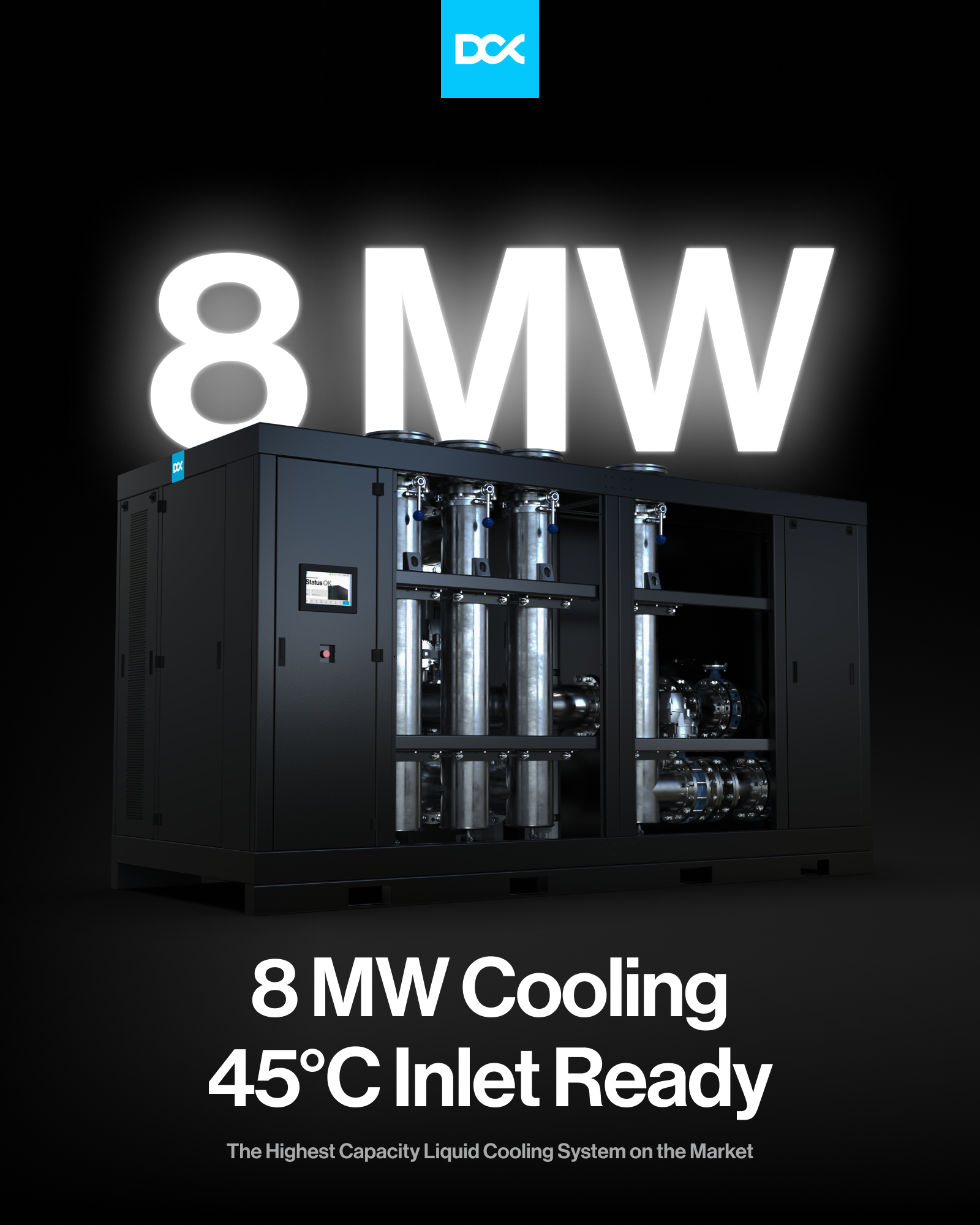
At the 2026 OCP Global Summit in San Jose, European liquid cooling specialist DCX Liquid Cooling Systems quietly shifted the narrative, showcasing its 8 MW+ Facility Distribution Unit (FDU) alongside a massive $176.08 million strategic partnership with power giant LITEON – DCX reminded the industry of a stark, immutable reality: You cannot scale AI power if you cannot handle AI plumbing.
To put an 8mw FDU into perspective – consider that a single one of these units can carry the thermal load of roughly six standard 1.3 MW row Coolant Distribution Units (CDUs). We are no longer talking about cooling individual racks or even rows of servers; we are talking about cooling entire data center halls with single, unified liquid cooling architectures.
This isn’t just an incremental hardware upgrade. It is a fundamental rethink of data center physics, driven by three critical shifts that this announcement brings to light.
1. The Death of Ambient “Chill”
The industry has spent a decade building data centers in sub-arctic regions just to leverage free air cooling. DCX’s flagship FDU series turns that paradigm on its head by optimising for 45°C (113°F) warm-water cooling.
By designing infrastructure that thrives on water temperatures that would make a human sweat, data center operators can drastically reduce, or entirely eliminate, the energy-intensive chillers that historically bloated a facility’s Power Usage Effectiveness (PUE). It means high-density AI factories can now be built closer to power grids and urban centers, rather than being banished to the Nordics or America’s rural plains.
2. We Need Electronic Chemists, Not Just Technicians
Perhaps the most overlooked, yet revolutionary, aspect of DCX’s OCP showcase was the introduction of the world’s first CDU system with automated electronic chemical dosing.
Until now, managing the water chemistry inside a massive liquid-cooled data center was a manual, high-stakes chore. If the pH level dropped or biocides degraded, bio-fouling or corrosion could instantly ruin millions of dollars of cutting-edge silicon. By embedding real-time water chemistry monitoring and automated dosing directly into the FDU, DCX is treating water quality like a software-controlled variable. For enterprise data centers hesitant to introduce liquid into their server rooms, this automation removes the single biggest operational anxiety holding them back.
3. Power and Cooling Are Consolidating
Historically, power supply and thermal management were handled by different vendors, installed by different teams, and managed in silos. LITEON’s massive strategic investment in DCX completely shatters those silos.
Seeing LITEON’s 800 VDC AI factory power solutions running in tandem with DCX’s heavy-duty thermal management at OCP is a window into the future of infrastructure design – at the densities required for next generation AI platforms, power and cooling are two sides of the exact same coin and must be engineered together.
The Bottom Line
The AI gold rush has spent years focusing on the “brains” of the operation – the GPUs. As compute density rockets to unprecedented heights, the bottleneck is rapidly shifting from how fast a chip can think to how fast we can pull the heat away from it.
DCX’s announcement is a wake up call for the industry – the future of AI isn’t just silicon and software; it’s massive, automated, highly sophisticated fluid dynamics, and the operators who fail to master the plumbing may well find themselves left out in the heat !