AI clusters are pushing network speeds towards 800G and beyond
More AI means more fibre and it’s creating a new kind of density problem: The challenge is no just moving more data, it is fitting, accessing and maintaining the fibre needed to move it.
Whilst obvious pressure points are GPUs, power and cooling – underneath the compute sits another increasingly crowded layer: the physical network connecting accelerators, servers and switches. As AI networks move from 100G towards 400G and 800G, operators need more high-speed optical connections packed into increasingly dense racks. Aginode say the rise of AI and higher-speed networking is changing fibre architecture and creating new requirements for density and scalability and the problem is that fibre does not become easier to manage just because network speeds increase – every connection still has to be installed, every cable still needs to be routed and identified and every connector needs to be accessed by a technician – making fibre density a serviceability problem.
When density starts working against you
There is an obvious temptation to maximise the number of connections that can fit into a rack but maximum density is not necessarily maximum operational efficiency.
If connectors are difficult to reach, technicians can spend more time making relatively simple changes – if fibre routes become congested, tracing an individual connection becomes harder and when an AI cluster is already carrying production workloads, maintenance cannot casually mean disturbing neighbouring connections . The physical network needs to achieve two things at once: high density and high accessibility.
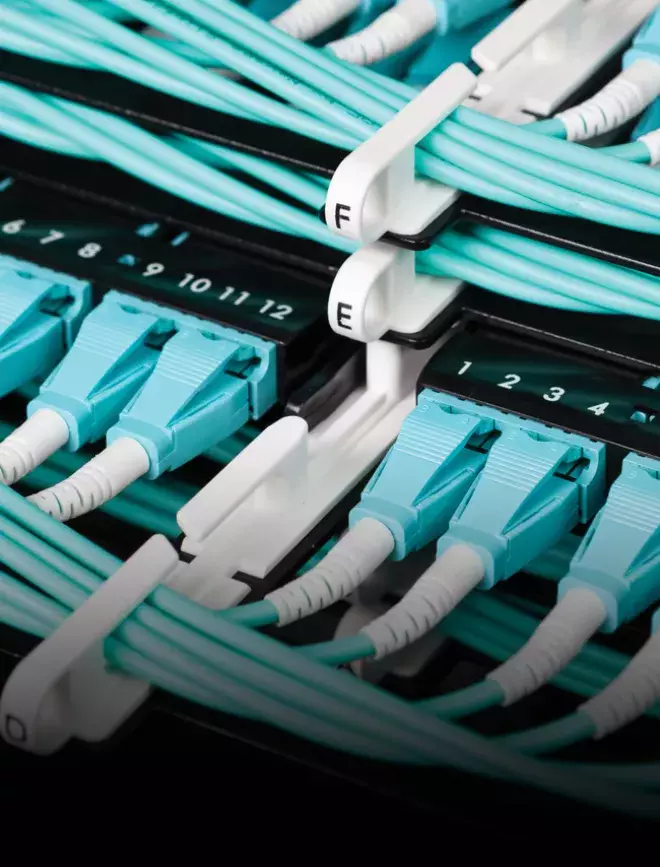
Aginode’s ENSPACE high-density fibre platform illustrates this approach, they specify configurations of up to 144 LC connections per rack unit while retaining access to the individual connections. The broader principle matters more than the specification here – operators need to pack in connectivity without creating a physical infrastructure that becomes harder to operate as it grows.
800G makes the problem more obvious
The move to 800G makes this increasingly important as higher-speed connections require more sophisticated optical infrastructure
AI clusters require enormous numbers of links, and at scale, small design decisions around connectors, cable routing and patching can have an big impact on installation and maintenance – even the connector becomes an operational consideration – which may sound like a minor engineering detail but inside a dense AI rack, it isnt – if a technician cannot comfortably reach a connector, then a simple change becomes harder, now multiply that across thousands of connections and the physical network starts to influence deployment time and maintenance efforts
Is serviceability becoming part of capacity planning
This is where the fibre-density problem becomes an operator problem
AI data centres are being designed for continuous expansion – Networks will be upgraded, new accelerators will arrive and cluster architectures will change, which all leads to the physical connectivity layer needing enough capacity for today’s deployment while remaining accessible enough to support tomorrow’s changes.
This is driving a wider shift across the industry – rack design, cable management, power distribution and cooling are increasingly being considered together, why? because they all compete for the same physical space – connectivity forms part of this equation now. It’s no longer just about how many connections can fit in a rack, its also about how many connections can fit while technicians can still reach them, maintain them and change them without the rack becoming a bottleneck and as AI clusters become denser, this distinction becomes an increasingly important consideration.